The Runway Set Is Not Just a Backdrop
A runway set establishes context before the first look appears, shaping how viewers read a collection through space, light, materials, and movement.
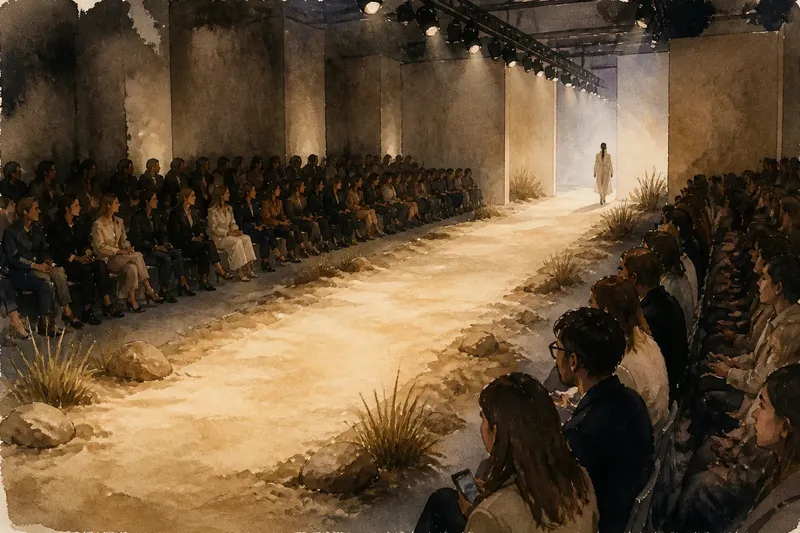
A runway audience settles into a dark room, then notices a narrow strip of pale sand running between the seats. Before a model appears, the sand has already changed the room: it suggests a landscape, makes the floor feel less like a stage, and gives the wait a particular mood. A runway set is not just a backdrop; it can establish context before the collection arrives.
That context is not a literal explanation of the clothes. Instead, scenery, light, sound, and the route models take give viewers a frame for attention. The set can suggest a place, a social atmosphere, a way of moving, or a tension the garments will later complicate. Understanding that work means looking at the show as a sequence: the audience encounters a space, then watches clothing alter its meaning.
What does a runway set tell the audience first?
A set makes an opening argument through physical choices. A long, bright corridor may invite attention to silhouette and pace; a crowded arrangement of chairs may make the room feel intimate or uneasy. Even an empty floor carries a position. It can leave the clothes alone with the architecture, or make the building itself feel like part of the collection’s world.
These impressions begin before anyone can inspect a hem or fabric. Viewers register scale, distance, temperature of light, and the relationship between the runway and the seats. A low ceiling can make a walk feel compressed. A broad, exposed route can turn the same walk into a public display. The scenery does not dictate one response, but it gives the audience material from which to form one.
That is why the set’s first job is often orientation rather than decoration. It tells viewers where they are, what kind of attention the room invites, and what may count as important. A rough surface might make polished clothes seem more composed; a carefully finished room might make an irregular garment stand out. The contrast is part of the presentation, not an accessory added afterward.
How can a set establish context without explaining the clothes?
Context works best when it leaves room for the garments to speak. A runway can borrow qualities from a setting—workroom, garden, transit hall, or domestic interior—without recreating that place in full. A few cues may be enough: a bench, a material underfoot, a row of practical lamps, or a route that bends instead of running straight. These elements suggest conditions rather than provide a diagram of the collection.
The distinction matters because a literal set can overdetermine what viewers think they are seeing. If every object points to the same theme, the clothes risk becoming illustrations. A more open setting lets viewers notice friction: a delicate dress against a utilitarian floor, for example, or a sharply tailored coat moving through a space that feels casual. The audience can hold both impressions at once.
Imagine a collection built around soft, layered garments shown in a room with a bare plywood platform and work lights. The setting might suggest making and rehearsal without claiming that the clothes are workwear. As the looks appear, viewers could notice how the softness sits against the platform’s blunt surface. The expected observable result is a reading shaped by contrast, not a single, fixed story supplied by scenery.
How do materials, light, and route shape that context?
Materials establish a tactile register, even when the audience cannot touch them. Timber, painted canvas, metal mesh, carpet, and stone-like surfaces carry different associations and absorb light differently. A reflective floor may multiply movement and draw attention toward the room; a matte one may keep focus on the passing garments. The useful question is not whether a material is impressive, but what kind of attention it organizes.
Light can separate the runway from its surroundings or make the two feel continuous. A concentrated pool of light gives each look a distinct entrance and exit. Broad, even illumination can make the room feel less theatrical and keep details visible across the route. Color also changes how materials and garments read: warm light can soften a hard surface, while a cool cast can make a familiar interior feel impersonal. Lighting choices are part of the set’s argument, not a neutral finishing touch.
The route supplies another layer. A straight runway makes approach, passage, and departure easy to follow. A loop or turn changes what viewers see first and how long a garment remains in view. Seating affects the experience too: a close audience may notice construction and movement, while a greater distance emphasizes overall shape. These choices distribute attention among the clothes, the room, and the people watching.
Sound belongs to the same system. A quiet room can make footsteps and fabric movement unusually present; a dense soundtrack can make the show feel more like a continuous environment. Sound may reinforce the set’s mood, but it can also resist it. A spare room paired with an insistent score, for instance, produces a different tension from a spare room in silence. The point is not to match every element, but to understand the effect of their relationship.
What should you look for when the show begins?
Does the set change how the garments move?
Notice whether the surface, route, or spacing affects a look’s motion. A long train on a tight turn, or a loose garment on a narrow path, may bring movement into focus in a way a flat, straight runway would not.
Does the scenery name a place or suggest a condition?
A recognizable room can anchor interpretation, while fragments such as a bench or work light may only imply use. Look for whether the collection depends on the setting’s literal identity or gains meaning from a looser atmosphere.
Where does your attention go between looks?
Transitions reveal what the set is doing when clothing is absent. If the room holds attention through changes in light, sound, or visible structure, it functions as an environment rather than a framed display.
Does the set support a reading or close it down?
Consider how many plausible relationships remain between garments and scenery. A set can make an idea legible without reducing every look to evidence for one interpretation.
When does scenery become a distraction?
A set becomes distracting when its visual demand overwhelms the clothes without adding a useful relationship. Oversized props, elaborate surfaces, or dramatic lighting can capture the room’s attention so completely that garments seem secondary. Spectacle is not automatically a failure; it may be the intended point. But viewers can ask whether the scenery changes their understanding of the collection or simply competes with it.
Scale and placement often explain the difference. A large object near the runway may interrupt sightlines, while a busy surface can blur a garment’s outline. Repetition can also make a visual cue feel insistent: if every part of the room announces the same mood, there is little space for contrast. What is not worth the effort is decoding every prop as a secret symbol. Some elements establish texture, rhythm, or distance without representing a hidden message.
Practical constraints matter, too. A set must leave clear paths for models and provide workable views for the audience; its construction and materials must suit the venue and the people using it. Those decisions belong to the production as much as the visual concept. Where a choice depends on venue rules, manufacturer directions, or safety requirements, follow those requirements rather than treating a visual preference as a reason to disregard them.
How can a viewer read the room before the first look?
Start with the parts that can be observed directly. Note the floor, walls, seating, route, light, and sound before assigning a theme. Then ask what each element makes easier to see and what it pushes into the background. This keeps interpretation grounded in the room instead of turning every object into a clue with a predetermined answer.
Next, watch for change. Does the environment remain stable as the collection progresses, or do lighting and sound shift? Does a route reveal the clothes from several angles, or preserve one dominant view? The set’s meaning may emerge through these changes rather than from a single opening impression. A final look can feel different when the audience has learned how the room handles movement and distance.
For runway set context, the most revealing question is often not “What does this scenery stand for?” but “What does it prepare me to notice?” That question leaves space for the clothes to confirm, complicate, or refuse the atmosphere around them. When the first model steps onto a runway, the set has already begun shaping the encounter; its most thoughtful work is to make that encounter more legible without deciding it in advance.